
Kindergarten Maths: What Your Child Should Know and How to Practice it at Home
As your child approaches kindergarten, math becomes a foundational subject for future academic success. Understanding what your child should know and how to support their learning at home is essential. This article explores key concepts and skills your child should master, from number sense to basic geometry, along with practical tips for practicing at home.
Understanding Kindergarten Maths
What is Kindergarten Maths?
Kindergarten maths focuses on building a strong foundation of mathematical understanding through hands-on activities. It’s about grasping *what* counting means and *why* it’s useful, not just reciting numbers. Children learn through play using manipulatives like blocks and counters. For example, combining two blocks with three to see they create a group of five helps solidify understanding through experiential learning.
Key Concepts and Skills
Several key concepts form the core of kindergarten maths. Number recognition is the ability to identify and name numbers from 0 to 20, understanding the quantity each number represents. One-to-one correspondence involves matching each object in a set to a number, demonstrated through counting toys, and lays groundwork for addition and subtraction. Shape recognition is also fundamental, children learn to identify and describe common shapes like circles, squares, triangles, and rectangles, introducing geometry foundations. For more ideas, see our guide to counting with a four-year-old.
Number Sense and Operations
Counting and Basic Addition
Counting involves understanding the quantity each number represents. Children move beyond rote counting to grasp the relationship between numbers and quantities. Basic addition is introduced visually using manipulatives like counters. A child might combine three blocks with two blocks and count the total, understanding the concept of “putting together.”
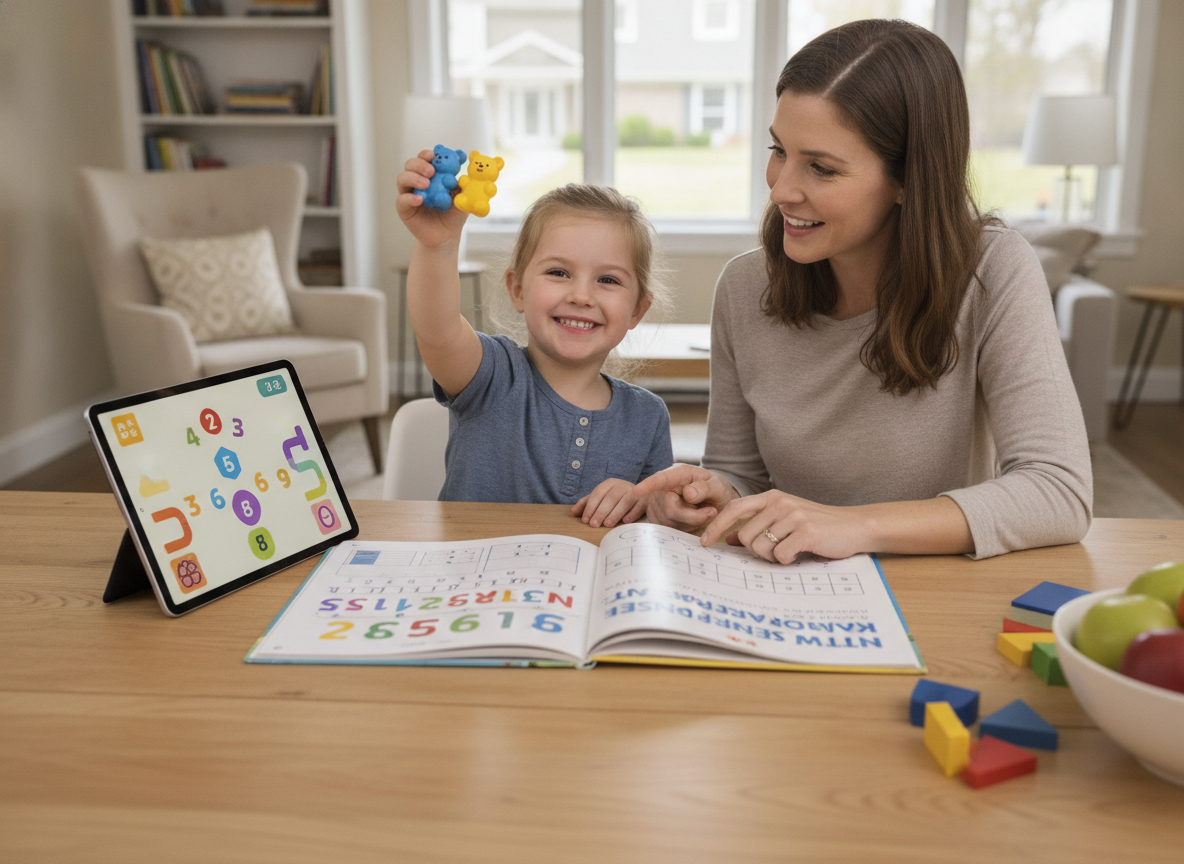
Photo by Quixess Social
Comparing Numbers
As children become comfortable with counting, they develop understanding of number comparison, determining which number is greater than, less than, or equal to another. Visual aids like number lines help visualize relative sizes. Children learn “more than” and “less than” through simple comparisons, such as comparing the number of apples in two baskets. Asking “How do you know that number is bigger?” encourages them to articulate their understanding. For enrichment, consider five kitchen-table science experiments to explore scientific concepts alongside mathematics.
Geometry and Measurement
Kindergarten maths extends beyond counting to introduce foundational geometry and measurement concepts, vital for spatial reasoning and problem-solving. These areas help children recognize shapes in everyday objects and grasp basic size and quantity concepts.
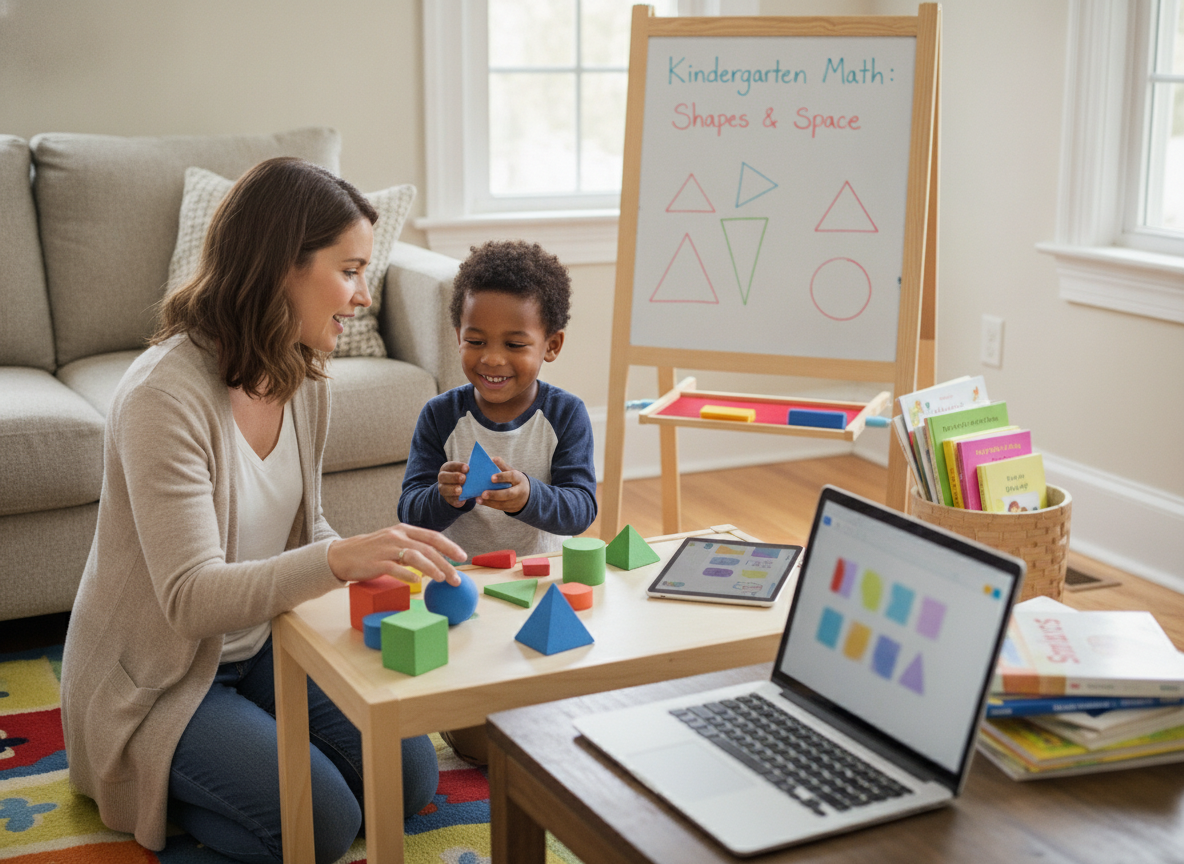
Photo by Quixess Social
Shapes and Patterns
Children identify and name common shapes, learning to describe their attributes, such as the number of sides a square has. Pattern recognition is closely linked to shape identification. Children learn to predict what comes next in a sequence, building logical thinking skills. Building with blocks is an excellent way to explore these concepts.
Measuring Length and Weight
Measurement begins with comparing objects, which is longer, which is heavier? Children often start with non-standard units like blocks to gauge length. Introducing scales begins weight measurement. Focus on comparisons at this stage.
Practical Tips for Practicing Kindergarten Maths at Home
Incorporating mathematical thinking into everyday activities solidifies understanding and fosters positive attitudes toward learning. While baking, have your child count eggs or measuring cups. During playtime, ask them to sort toys by color, size, or shape. Sorting laundry by color reinforces categorization skills. These become valuable learning opportunities when framed with a mathematical question.

Photo by Quixess Social
Board games often involve counting and number recognition, while simple card games help with comparing numbers. Create scavenger hunts with clues involving shapes or numbers. Online games designed to reinforce kindergarten maths concepts are also helpful, balance screen time with hands-on activities.
Conclusion
By understanding what your child should know in kindergarten maths and practicing these skills at home, you help build a strong foundation for future academic success. It’s about developing problem-solving skills and a love of learning. Stay patient and supportive, encouraging your child to ask questions and explore. Tutorpip offers resources to help your child master kindergarten maths.