
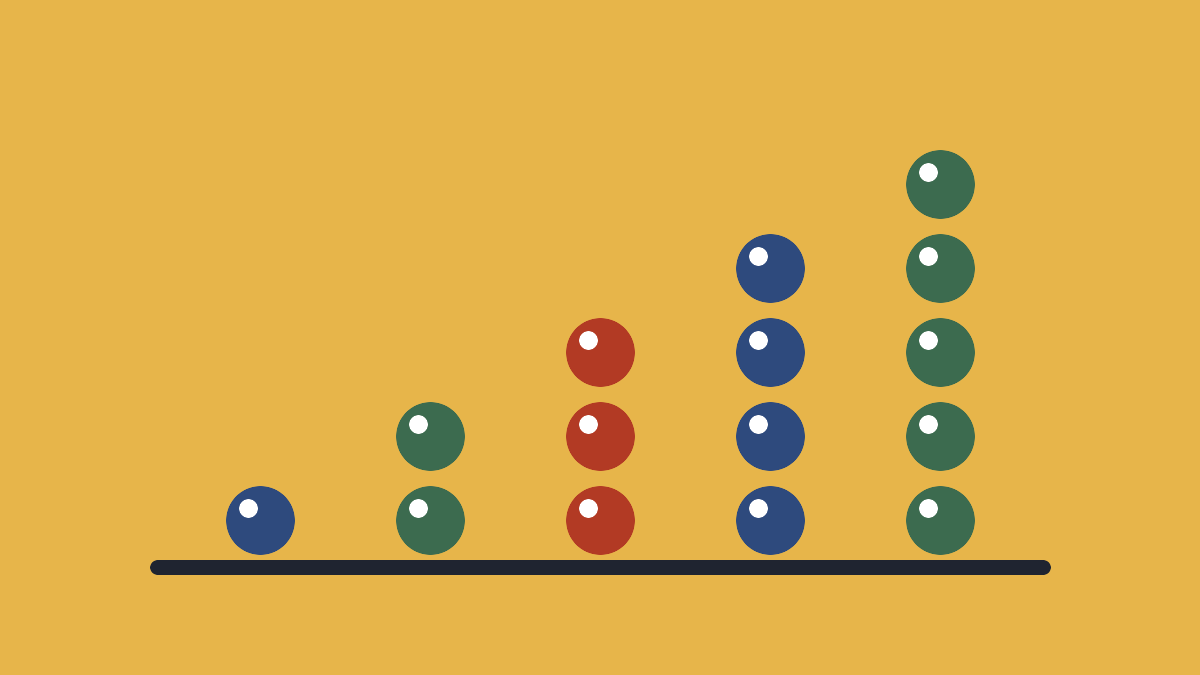
Many four-year-olds can recite the numbers from one to ten like a song. That is a good start, but it is only the first piece of counting. Real counting means something more: knowing that each object gets exactly one number, that the last number you say tells you how many, and that the same group is the same amount however you spread it out.
You do not need flashcards for any of this. Your day is full of things to count. Here is what to look for, and ten games to play along the way.
The four ideas behind counting
- The number words, in order. One, two, three, four… in the same order every time. This is the part that sounds like a song.
- One number for each thing. Touching or moving each object as you say its number word. This is called one-to-one correspondence, and it is where most mistakes happen: the voice runs ahead of the finger, or a thing is skipped or counted twice.
- The last number is the total. Ask “how many?” after counting. A child who counts “one, two, three” and then, asked how many, starts again, is still learning this idea.
- Seeing small groups at a glance. Most people can tell 2 or 3 (and often 4) without counting. This is called subitizing, and it makes later addition easier.
Children vary a lot in when these click. If you are worried, mention it to your pediatrician or your child’s teacher, but do not worry just because the neighbor’s child is further ahead.
Ten games
1. Count the steps
2. Snack count
3. Set the table
4. Color hunt
5. Flash the fingers
6. More or fewer
7. Jump and count
8. Sock pairs
9. Blast-off
10. Bedtime tally
Tips that help
- Touch and move. Slide each counted object to a new place so nothing is counted twice.
- Go slowly. If the finger and the voice disagree, slow down together.
- Stay small. Stay with numbers up to ten until one-to-one counting is steady. There is no prize for getting to 100 early.
- Praise the effort. “You counted them carefully” is more useful than “good job”.
- Keep it short. Two minutes of game, then stop on a high note.
Where this leads
These are the skills the Head Start Early Learning Outcomes Framework lists for number sense in preschool, and the skills Kindergarten builds on: counting to 100, writing numbers, comparing groups and starting to add and subtract with objects.
If you would like a little help, Tutorpip’s Pre-K maths lessons are free to play with no account. The tutor talks and the child answers by touching. There are also free Pre-K worksheets to print.